| Communication |
Pictures drawn by rural communities in Rajasthan or Gujarat are recognised in villagers in rural Karnataka or Andhra, indicating that visual grammer is often similar amongst non-educated people. Yet, the assumption cannot be made. Field testing in every village and to local audiences is still indispensable to comprehension and effective implementation. |
 |
Translation and Integration
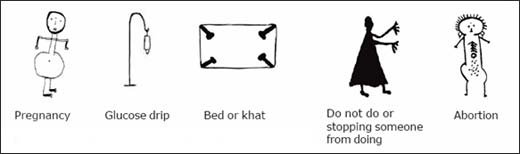
The visual grammer of an audience is the foundation upon which all media material can be based. The first step therefore is, compiling a picture dictionary.
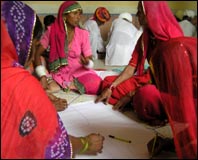
Conduct drawing sessions: ask the audience to draw:
- own house, own family
- marriage, festival, patterns (mandana) in a wedding
- household duties, daily activites
- village meeting
- what makes you happy, what makes you sad
These drawings will reveal plenty of issues.
- The environment and surroundings in which the audience lives
- Local representations of people, activities, and objects, etc.
- Narratives of events, shown without sequence
- The resources accessible or available to them
- How women see view themselves (health and social status) in their community
- Issues of exclusion; the existing gaps in communication channels
Example 1 of integration: Final picture, a page from a training book on abortion:
Population Council: 2004 - 2005
The intended message on the page:
- Abortion is legal up to 20 weeks of pregnancy.
- If you are above 18 years of age , you require just your own signature.
- Abortion is illegal beyond 20 weeks of pregnancy
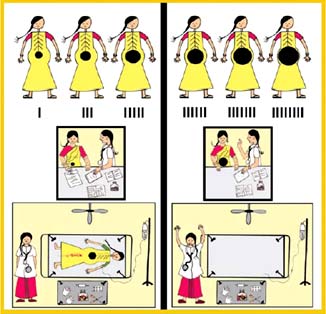
These elements from the picture dictionary were included for the above final picture.
Example 2 of integration: Final picture, a page from a training book on HIV/AIDS
RCDCSSS, Ajmer. 2006
The intended message on the page:
- Do not drink.
- Do not do drugs.
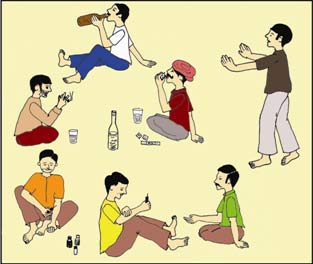
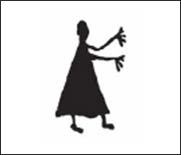
This element was used to convey do not do rather than use a 'cross' to convey 'wrong'